

If you live in the UK and wonder which Schengen visa is easy to get from the UK, the following information is for you.
I’ll take you through some key facts, highlighting the countries in the Schengen that usually have higher approval rates, with practical tips to help you smooth out your application process. Yes, it does matter which country you apply through, how you prepare, and when you apply.
The basics: What is the Schengen visa and who needs it?
The Schengen visa is a short-stay visa that allows you to visit the Schengen Area of Europe for up to 90 days in any 180-day period. If you’re resident in the UK but not a British citizen-or you hold a passport that does require a visa-you will likely need a Schengen visa.
If you are a British passport holder, for most Schengen countries you will not need a visa for short stays (tourism), but you will need the relevant national visa for longer stays, work, or study.
This article focuses more on those who do need to apply for a short-stay Schengen visa from the UK-for example, non-UK passport holders resident in the UK-and who want to choose a country with the highest chance of approval.
Why “which Schengen visa is easiest” matters?
The choice of country for the Schengen visa application is very important because:
- Some Schengen countries have much higher approval rates compared to others, meaning lower rejection rates. Some consulates/visa centers in the UK give easier appointments and/or quicker processing.
- The strategic mindset allows you to be more successful with less stress: booking appointments, gathering documents, etc.
Hence, asking which Schengen visa is easy to get from the UK is smart-you’re looking for both a high approval rate and manageable logistics.
Top Schengen countries (from UK) with higher approval / lower rejection
Here are some of the more “friendly” Schengen states (in terms of success rates) when it comes to UK-based applicants, which repeatedly appear in data.
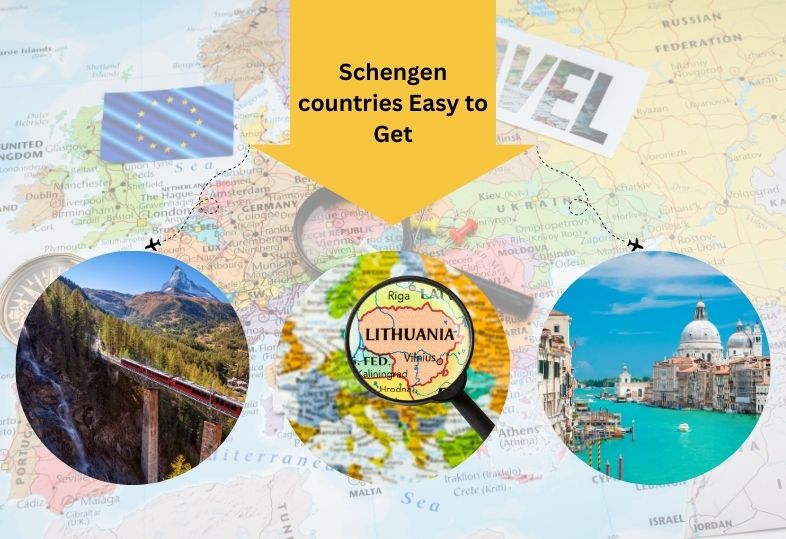
Lithuania
Lithuania is often mentioned as one of the easiest for UK-based applicants. Statistics show very high approval rates, as high as 97 %+ in certain years, with smoother processes.
Pros: Fewer appointments, good for first-time applicants.
Cons: You must still meet the requirement of “main destination” or “first point of entry” so you’ll need your travel plan set.
Latvia
Also strong: the rejection rate among UK applicants is relatively low, about 10 percent or less in some data sets, for a short-stay visa.
Good choice if your itinerary allows entry via Latvia, or you’ll be spending most of your time there.
Italy
Italy appears to be a good option: a popular destination with still-manageable rejection rates, standing at around 10-11% in some years. Easiest Schengen Visa+1
Benefit: It’s a well-known destination; that can work in your favor if your travel plan is clear.
Switzerland
Not an EU member but part of the Schengen area, Switzerland also figures amongst the lower-rejection countries (in terms of UK applicants) with around 11-12% refusal during these last years. Easiest Schengen Visa
If your journey involves Switzerland, or if you can submit an application via its visa center, this may be a possibility.
Slovakia
When you review approval data from 2023/24, Slovakia also charts well in some lists – approval or low rejection. Less obvious, but worth considering if your travel plan matches.
Luxembourg
Smaller country, fewer applications compared with big EU states; probably more careful case-by-case handling, also fewer refusals.
Hungary
Among mid–low refusal rate countries, although demand is higher than in the case of very small states, Hungary’s visa system appears to maintain a reasonable approval rate overall.
Norway
Being a non–EU Schengen country in moderate demand, Norway has relatively low rejection rates, which may suggest decent approval chances for well-prepared applications.
Why these countries tend to have lower Schengen-visa refusal rates
- Lower application volume / less pressure on consulates: Smaller or less-tourism-heavy Schengen countries-for example, Iceland, Latvia, Slovakia, and Bulgaria-receive fewer visa applications. This lower volume often allows for more personalized processing, reducing the chance that applications are rejected because of overwork or blanket suspicion.
- Efficient visa-processing system and experience: In countries like Italy and Switzerland — despite high demand — visa processing systems are mature, structured, and capable of handling large numbers of applications, which helps maintain moderate refusal rates.
- Relatively lower “risk profile” / applicant screening pressure: For some of the smaller or the newer Schengen states, or those with fewer overstays, the risk of visa abuse or illegal stay might be considered lower. Consulates may therefore be more lenient or flexible when evaluating legitimate tourist or short-stay applications.
- Balanced demand v capacity: Countries for which the number of visa applications is in line with the administrative capacity-not overwhelmed but also with relevant experience-find a balance that is supportive of reasonable approval rates. For example, this applies to Hungary, Luxembourg, and Norway.
Important caveats: low rejection rate ≠ guaranteed approval.
- The refusal rates are global aggregates, all nationalities, whereas your personal chances depend a lot on your nationality, travel history, documents, purpose of visit, etc. For instance, refusal rates for some nationalities may be very high, such as for some Asian or African countries.
- Low rates can be a result of few applications: e.g., Iceland’s low number may reflect few visa requests — but that doesn’t mean it is necessarily easy for everyone.
- Policies and demand fluctuate: visa rules, application surge, and consulate workload differ yearly, so what was “easiest” in 2024 may not hold in the future.
- “Easiest” doesn’t waive the requirements: You still need to have complete and accurate documentation, clear travel intent, financial proof, etc. In even “low-refusal” countries, weak applications get denied.
What to check before choosing the country to apply
When choosing “which Schengen visa is easiest” for you in the UK, check:
- Major destination rule: The Schengen rules allow someone to apply at the country where one intends to spend most of their time. If the time is equal, then the country of first entry. This should align, or else there is a chance of a rejection.
- Appointments: Visa centers of some countries in the UK have long waits or limited slots. Posts on reveal difficulties booking some countries.
- Documentation language / requirements: Even though Schengen rules strive towards standardization, every country could ask for slightly different supporting documents: bank statements, travel insurance, invitation letter, and so on.
- Processing time: Many visas are within ~15 calendar days, though some are more expedient. Others may take longer during peak seasons.
- Track record / refusal rate data: As above, select the country with relatively low refusal rates, if you have a choice.
Your profile: First-time applicant vs. repeat applicant, your travel history, whether you hold a UK residence permit, your nationality, etc. All matter for how “easy” it will feel.
Step-by-step: How to maximize your chances of “easy” approval
Even applying to one of the more favorable countries requires that you do some groundwork. Here is a simplified step-by-step:

1. Eligibility check
Make sure that, based on your nationality, you need a Schengen visa; if applying from the UK, you should fulfill the residence criteria in the UK.
2. Main destination/first entry
Choose country which you apply in, according to where you are supposed to spend most of your time or first arrive.
3. Book appointment
Early – do not wait until the last minute, especially during peak seasons.
4. Prepare all documents, usually
- Completed visa application form for that country’s centre
- Valid passport (with enough validity after trip)
- Proof of UK residence (e.g., BRP, utility bills) – if a non-UK passport holder
- Travel itinerary: flights, accommodation
- Travel insurance covering Schengen area
- Bank statements showing you can support yourself
- Cover letter explaining purpose + timeline of trip
5. Submission at visa center
Appear in time, present documents, and biometric if needed.
6.Wait for decision
Usually 7-15 working days, may vary.
7. Receive visa / travel
Once approved check the validity dates carefully (entry, exit, number of entries).
8. Abide by rules:
Do not overstay; maintain the visit purpose; carry all your documents while traveling.
Common misconceptions & pitfalls
Even with a “friendly” country things can go wrong. Beware:
- Thinking “easy” means no documents: it still requires full and correct paperwork. If you submit weak documentation, you can be rejected even then.
- Assuming same process for everyone – Your nationality or UK residency status may mean extra scrutiny.
- Forgetting to apply under right country: If you choose for example Latvia because it is “easy”, but you will actually spend most days in France, you may get rejected for applying via the wrong country.
- Waiting until last minute for appointment – Especially in summer or around holidays, slots fill up.
- Ignoring validity & restrictions: Some visas could be single-entry or for a shorter period. Prepare for that.
FAQS – about which Schengen visa is easiest from UK

Data shows that countries such as Lithuania, Latvia, Italy, and Switzerland have higher rates of approval, or lower rates of rejection, for UK-based applicants.
No, there is no guarantee; you still must meet all the requirements and apply correctly. The “easiest” label refers to statistical higher approval and smoother logistics, not a shortcut.
Yes, if your nationality usually requires a Schengen visa. UK residence will not automatically exempt you.
You can apply as early as 6 months prior to travel for tourism, or at least 15 days before travel. But the earlier, the better for appointment availability.
In that event, you’d have to consider the next best alternative, one of the countries with high approval rates, or plan booking alerts. Forums suggest monitoring weekly and being flexible.
Key Consideration
- For applicants based in the UK, choosing the right Schengen country enhances the possibility of getting approval and also ensures smoother processing.
- Countries like Lithuania, Latvia, Italy, and Switzerland show better approval trends.
- But make sure that your travel plan supports that choice (main destination / first entry).
- There should be full, correct documentation, early booking, and a clear purpose.
- The term “easy” is relative: Higher chances, but not automatic.
Conclusion
So, when asking “which Schengen visa is easy to get from the UK”, you are asking in essence: Which country gives me the highest chance of getting a visa and the smoothest process from my UK base? The answer would be to go for one with a low rejection rate and favorable processing, such as Lithuania, Latvia, Italy, or Switzerland, align your itinerary accordingly, and be well-prepared. With that, you’ll minimize stress, boost your chances, and be ready for that European break.
Add a Comment